How to Update Your ARC Address in Korea: HiKorea Online & In-Person Guide (2026)
July 24, 2026
- Registered foreigners must report a new address within 15 days of moving in (Immigration Control Act, Art. 36). The old “14 days” figure was changed to 15 in December 2020. Overseas Koreans who filed a domestic residence report (F-4) still have 14 days under a different law.
- You can report at the gu/city office or dong community center for the new address, at the immigration office that covers it, or online through HiKorea.
- Online reports do not get the new address written on the back of your ARC. If you want it recorded, go to the immigration office and ask.
- Not reporting is not a “fine” in the parking-ticket sense. It is a criminal offence (up to KRW 1,000,000) that immigration normally settles with a notice fine of KRW 100,000 to 1,000,000 depending on how late you are.
- The 1345 Immigration Contact Center runs weekdays 09:00-22:00, about 20 languages, English included. It is not a 24/7 line.
Moving house in Korea has an extra step that most people from abroad never had to think about: the government expects you to tell it where you live, and the legal clock starts the day you move in. This is the main guide on the site for that step. The visa-specific pages (E-9, F-2, E-7, D-10) only cover what is different for that visa and send you back here for the procedure.
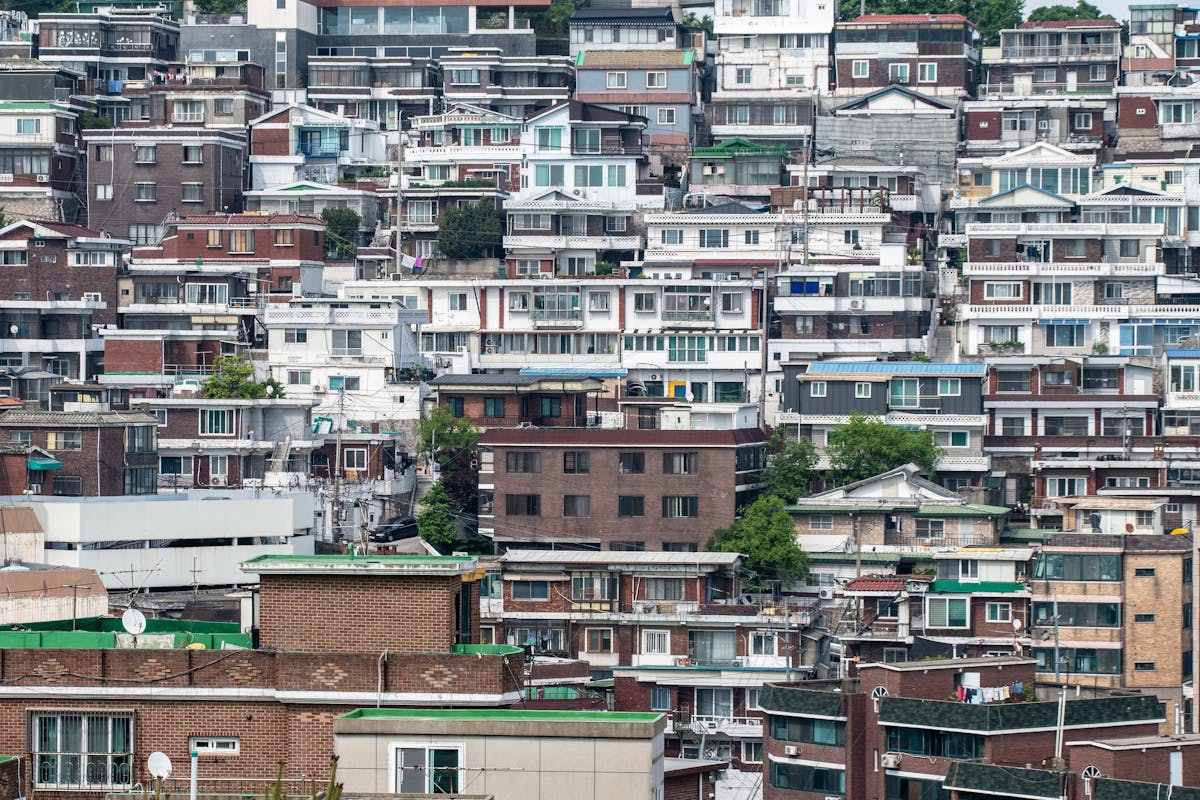
Residential buildings in Seoul. Stock photo, not a specific address.
Who has to report, and what it is called
The report is called 체류지 변경 신고 (change of place of sojourn), also called a “move-in report” (전입신고) in the law. It applies to everyone who has completed alien registration, i.e. anyone who stayed in Korea more than 90 days and holds an ARC (or the mobile ARC), whatever the visa type. It is a separate step from the resident registration move-in report Koreans file with the dong office, but for foreigners the immigration report is the one that counts.
- Registered foreigners (ARC holders): 15 days, Immigration Control Act Art. 36(1).
- Overseas Koreans (F-4) who reported a domestic residence instead of registering as foreigners: 14 days, Overseas Koreans Act Art. 6(2). See the F-4 section below.
- Under 17: the law lets immigration skip issuing a card to children under 17, so ask the counter how a child’s address is handled when you file for the parents.
- Short stays under 90 days without an ARC: no report. The hotel or host registers you at check-in where required.
The deadline: 15 days from the day you move in
The period runs from the date you actually move into the new address, not from the lease signing date or the contract start date. Weekends and holidays count. Many guides, and older versions of this page, still say 14 days. That was the rule until the amendment that took effect on 10 December 2020 (Act No. 17365), which moved the deadline for both the change of place of sojourn and the change of alien registration details to 15 days.
Practical advice: do not plan around day 15. The online route can take up to three working days to process and you may be asked to supplement documents. File in the first week.Where you can report
| Where | Good for | Watch out for |
|---|---|---|
| Gu / city / eup-myeon-dong office for the new address (the civil affairs counter or dong community center) | Most people. Usually no appointment (confirm locally) | Staff may have little English. Bring the Korean address written out |
| Immigration office that covers the new address | Asking staff to write the change on your ARC; reports after the deadline; anything unusual | Appointment through HiKorea is usually needed. See the office list |
| HiKorea e-application (online) | People who live far from an office | No address written on the card; supplement requests come through your HiKorea account |
The law (Art. 36(1) and Enforcement Decree Art. 45(1)) names exactly these two kinds of offices: the head of the si/gun/gu or eup/myeon/dong of the new address, or the immigration office with jurisdiction over it. It also says the report may be filed through a network designated by the Minister of Justice, which is the legal basis for HiKorea. One Seoul district office’s guide states that after the deadline you can no longer file online and must go to the immigration office. The law itself says nothing like that, so if you are late, start with the immigration office or call 1345.
Reporting online through HiKorea
HiKorea is the Ministry of Justice portal (hikorea.go.kr, English available). The steps below follow the Guro-gu Office’s published guide to the online report:
- Sign up for HiKorea and log in. The gu office’s guide mentions a digital certificate for login; if you do not have one, check which login methods HiKorea currently offers or use the counter.
- Go to e-application (전자민원) and choose 체류지변경신고 (Change of Place of Sojourn). Families registered under one household head (F-3 dependents) can be filed together by the head.
- Enter the new address. The address search is in Korean, so copy the road-name address from your lease or from juso.go.kr, then add building, dong and ho.
- Upload proof of the new address and submit.
- Watch the result under My Page. The office processes it within about three working days (weekends and holidays excluded). If it is returned for supplement, fix it under the e-application status list and resubmit.
Online filing does not write the new address on the back of your card. The law says the receiving office records the change on the ARC (Art. 36(2)), and the gu office’s guide says online filers who want it written have to visit an immigration office. For the mobile ARC the change is simply recorded in the app (Art. 36(8)).
Reporting in person: what to bring
- ARC and passport (originals)
- The unified application/report form (통합신청서, Enforcement Rule Form No. 34), available at the counter or on HiKorea
- Proof of the new address (table below)
- If someone files for you: a power of attorney and their ID. Ask the counter what else they want, since requirements for proxies differ by office
I found no fee listed for the report itself on the pages I checked. Confirm with 1345 before you go.
 Bring originals. Stock photo.
Proof of address by housing type
| Your situation | What the counter usually accepts |
|---|---|
| Renting in your own name | Signed lease (임대차계약서) with the full address |
| Living in a room or house leased by someone else | The tenant’s or owner’s confirmation that you live there (거주·숙소제공확인서) plus a copy of their ID, and often the lease |
| University dormitory | Dormitory move-in confirmation from the international office |
| Employer housing or company dormitory | Letter from the employer or dormitory operator stating the address |
| Goshiwon, guesthouse, hostel | Operator’s confirmation and, in practice, their business registration and your rent receipt. See the goshiwon and hostel guide |
Offices differ on what they take, so match the address on the paper exactly to the address you type. If the paper shows only an old lot-number address, convert it to the road-name version first.
Example of the conversion step, using the Seoul Immigration Office itself (checked against juso.go.kr): 서울특별시 송파구 정의로 55 becomes 55 Jeongui-ro, Songpa-gu, Seoul 05835. Unit numbers are added in front in English format, for instance “Room 1203, 55 Jeongui-ro…” (the room number here is only to show where it goes). To turn your own Korean address into that English form, paste it into the Jusome converter.
What happens if you do not report
The consequence is criminal, not a plain administrative fine. Under Art. 98(2) of the Act, breaching the duty to report a change of place of sojourn is punishable by a fine of up to KRW 1,000,000. In practice immigration offers a notice fine (통고처분 범칙금), set by the Enforcement Rule (Art. 86 and Annex 7) according to how late you are:
| How late | Standard amount |
|---|---|
| Under 3 months | KRW 100,000 |
| 3 to under 6 months | KRW 300,000 |
| 6 months to under 1 year | KRW 500,000 |
| 1 to under 2 years | KRW 700,000 |
| 2 years or more | KRW 1,000,000 |
The office may reduce or raise the amount by up to half. The “10/30/50/100” 과태료 (administrative fine) that you may see online belongs to a different duty, reporting changes to your alien registration details (name, passport, nationality) under Art. 35. Many English guides mix the two. Overseas Koreans have their own rule, below. Immigration also sees your address history when you extend or change status, so a long gap is worth avoiding for that reason alone.
Overseas Koreans: F-4 domestic residence report (and what happened to H-2)
This section replaces the separate F-4 and H-2 pages.
F-4. Overseas Koreans can report a domestic residence (거소신고) instead of registering as foreigners. The first report is due within 90 days of entry. A move inside Korea has to be reported within 14 days, to the si/gun/gu or eup/myeon/dong office of the new address or to the immigration office covering it, or online. HiKorea’s own page gives the penalty for not reporting a change as an administrative fine of up to KRW 2,000,000 (different from the criminal fine above because it is a different law). Documents for a change: the F-4 form, passport, the Overseas Korean Resident Card (거소신고증), and proof of the new address. In-person first reports need a HiKorea reservation.
H-2 (Working Visit). Since 12 February 2026 the Ministry of Justice has merged the Korean-descent statuses into F-4: new H-2 visas are no longer issued, and existing H-2 holders may switch to F-4 before their stay period ends. The H-2 status itself still exists in the Enforcement Decree, so someone who still holds an H-2 ARC is a registered foreigner and follows the 15-day rule in this guide. If you move to F-4, your deadline becomes the 14-day domestic residence rule. Do not write “H-2 was abolished” on forms or in messages to employers; “new issuance stopped” is the accurate statement. Whether you will be treated as an alien-registered F-4 or as a domestic-residence F-4 depends on what you filed, so check your card or ask 1345.
After the report: the rest of your address chain
Reporting to immigration does not update anyone else automatically except where noted.
| Who | What to do | Guide |
|---|---|---|
| Landlord lease protection | For foreigners the registered change of sojourn works as the move-in report (Immigration Control Act Art. 88-2(2)). A confirmed-date stamp on the lease is a separate step | Lease contract guide |
| Health insurance | Check that NHIS has the new address. It is not clear that the immigration report is passed on automatically | NHIS address update |
| Bank | Match the new ARC address; branch rules differ | Bank guide |
| Phone carrier | App, store or 114 | Carrier guide |
| Mail from the old place | Korea Post forwarding (주거이전 우편물 전송), 3 months free within the same zone | Moving checklist |
| Car registered in your name | The sojourn report counts as the vehicle address change if your address is the car’s base. Registration changes otherwise run 30 days | Moving checklist |
| Driver’s licence | Check with the licence authority | Licence guide |
Getting help in English
- 1345 Immigration Contact Center: dial 1345 in Korea, +82-2-1345 from abroad. Weekdays 09:00-22:00; English, Chinese and Korean are covered after 18:00, and about 20 languages are covered in daytime hours.
- Seoul Immigration Office, Sejong-ro branch: Seoul Global Center, 38 Jong-ro, Jongno-gu, Seoul 03188 (floors 2 and 3). Seoul’s main office moved on 19 October 2026 to 55 Jeongui-ro, Songpa-gu [05835]; Yangcheon-gu residents now fall under the Seoul Southern office at 48 Magokseo 1-ro, Gangseo-gu [07799]. All other offices are listed in the office guide.
FAQ
Can I report before I move? The duty runs from the move-in date, so file after you have moved in and have the paper that shows the address. A report before you have any proof of the new address is likely to be returned.
Do I need a new ARC? No. The change is recorded in the immigration system. If you want it on the back of the physical card, ask at an immigration office. A reissue is a separate application with its own fee.
What if I move twice in two weeks? Each move is its own report.
I only changed rooms inside the same building. If the address (including the unit number) changed, report it.
Does the dong office report to immigration for me? If you file the change at the dong or gu counter, you have filed with an office the law names, so it is a valid report. Ask the clerk to confirm it was entered as a foreigner’s change of sojourn and not only a local move-in.
Related guides by visa
E-9 (employer housing) · F-2 (living with family) · E-7 · D-10 (after graduation) · first registration and offices
Sources
- Immigration Control Act, Art. 31, 35, 36, 88-2, 98 (law.go.kr)
- Immigration Control Act Enforcement Decree, Art. 45 and Enforcement Rule Art. 86, Annex 7 (law.go.kr)
- Act on the Immigration and Legal Status of Overseas Koreans, Art. 6 (law.go.kr)
- HiKorea: Reporting on Place of Residence (Overseas Koreans)
- Guro-gu Office: online change-of-sojourn report
- Immigration Contact Center (1345) hours and languages, immigration.go.kr
- Ministry of Justice press release on F-4 integration, 11 Feb 2026 (korea.kr)
I compiled this from the sources above. Rules and office addresses change, so confirm on HiKorea or with 1345 before you file.
What to do next
Guides for actually using your Korean address abroad.