Korean Goshiwon Living: Address Format for Foreigners
August 01, 2026
If you are a foreigner moving into a goshiwon in South Korea, one of your first questions is almost certainly: how do I write my address in English? Goshiwon (고시원) are among the most affordable housing options in Korean cities, but their address format confuses many new arrivals — especially when filling out visa applications, bank forms, or international shipping labels.
This guide explains exactly how to format a Korean goshiwon address in English, what each part of the address means, and how to use it for alien registration, mail delivery, and official documents. All information is based on Korea’s official road name address system (도로명주소), which has been the legal standard since July 29, 2011.
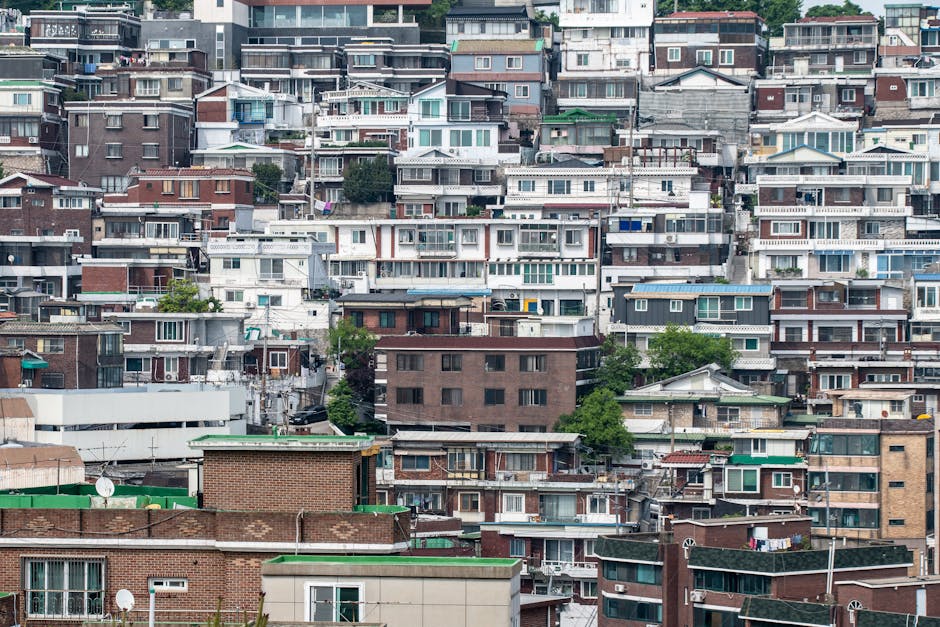
Dense residential neighborhoods like this are home to thousands of goshiwon facilities across Seoul. (Source: Pexels)
Key Takeaways
- Korea officially adopted the road name address system on July 29, 2011; the old lot-number system was decommissioned on December 31, 2013.
- A goshiwon address in English follows the format: Room [호], [Number] [Street-name], [District], [City] [Postal Code], South Korea
- Street suffixes indicate road width: -daero (8+ lanes), -ro (2–7 lanes), -gil (smaller side streets)
- South Korea uses a 5-digit postal code for all addresses.
- As of 2008, 108,428 people lived in 3,451 goshiwon facilities in Seoul alone. (Source: Wikipedia / Seoul city data)
What Is a Goshiwon?
A goshiwon (고시원), sometimes spelled gosiwon or called goshitel (고시텔), is a type of single-room occupancy building found throughout South Korea, particularly in major cities like Seoul, Busan, and Incheon.
Under Korean law, goshiwon are legally classified as an “industrial activity that operates boarding businesses or other unclassified accommodation facilities.” They first emerged around 1980 when Seoul’s urban slums were redeveloped into apartment complexes, and their use surged sharply after the 1997 Asian financial crisis. (Source: Wikipedia – Gosiwon)
Who Lives in a Goshiwon?
Goshiwon were originally designed for students preparing for civil service or bar examinations. Today the resident profile is much broader:
- University students and exam takers seeking budget accommodation near study halls
- Young office workers who have just relocated to a new city
- Foreign workers and exchange students on short-term stays
- Low-income adults including elderly residents and those receiving basic livelihood support
Goshiwon numbers in Seoul grew from 811 facilities in 2001 to 2,814 in 2006, reaching 3,451 by mid-2008 — housing approximately 108,428 people in Seoul alone during that period. Nationwide there were 4,211 goshiwon as of January 1, 2006. (Source: Wikipedia – Gosiwon, Seoul city data)
What to Expect Inside a Goshiwon Room
- A bed, small desk, and minimal storage within a compact private room
- Shared bathrooms and kitchens (private en-suite options exist but cost more)
- No meal service — unlike traditional hasukjib (하숙집) boarding houses, goshiwon do not include meals
- Month-to-month rental contracts
 A compact room typical of affordable housing options in Korea. (Source: Unsplash)
South Korea’s Road Name Address System Explained
To correctly write a goshiwon address, you first need to understand how Korean addresses work. South Korea officially adopted the road name address system (도로명주소) on July 29, 2011, and fully decommissioned the old lot-number system (지번주소) on December 31, 2013.
The new system is similar to addressing in the United States, Canada, and Western Europe — built around street names and sequential building numbers, designed to make navigation easier for both Koreans and foreigners. (Source: Wikipedia – Addresses in South Korea)
Street Name Suffixes: -daero, -ro, and -gil
Every Korean street name ends in one of three suffixes indicating the road’s width:
| Suffix | Korean | Road Width | Example |
|---|---|---|---|
| -daero | 대로 | 8 or more lanes | Gangnam-daero |
| -ro | 로 | 2–7 lanes | Sinchon-ro |
| -gil | 길 | Smaller side roads | Sajik-ro-3-gil |
Side streets that branch off a main road use a hyphenated number before -gil. For example, “Sajik-ro-3-gil” is the 3rd side street diverging from Sajik-ro. Many goshiwon are located on -gil streets.
How Building Numbers Are Assigned
Building numbers increase by 2 every 20 meters, with odd numbers on the left side and even numbers on the right side when facing the direction of increasing numbers. If a building sits on an unnamed alley, or if multiple buildings occupy the same interval, hyphenated numbers are used — for example, 12-1, 12-2, 12-3. (Source: Wikipedia – Addresses in South Korea)
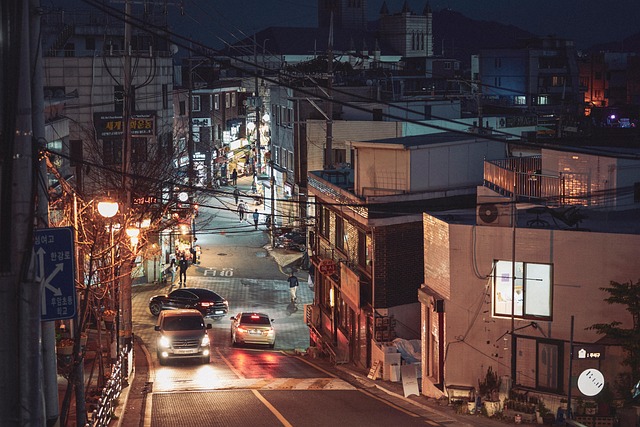 A Seoul street at dusk. Korea’s road name address system uses street names like this to assign building numbers. (Source: Pixabay)
Goshiwon Address Format in English
A goshiwon address in English follows the Western convention — from most specific (your room) to most general (country). Here is the complete structure:
[Your Name]
Room [호 number], [Building Number] [Street Name]
[District]-gu, [City] [5-digit Postal Code]
South Korea
Format Example (Using Wikipedia Reference Structure)
Gildong Hong
Room 201, 23 Sajik-ro-3-gil
Jongno-gu, Seoul 03174
South Korea
Breaking this down:
- Room 201 — your specific room number (호실/호). This is the 호 (ho) shown on your room door and rental contract.
- 23 — the building’s number on the street
- Sajik-ro-3-gil — the street name (3rd side street off Sajik-ro)
- Jongno-gu — the district (구). Written lowercase with a hyphen, not translated into English.
- Seoul 03174 — city name followed by the 5-digit postal code
- South Korea — always written in English for international mail
Finding Your Goshiwon Room Number (호)
Your room number is typically found in three places:
- Posted on your room door
- Written in your rental contract (계약서)
- Listed on the fire evacuation map posted in the hallway
Korean room numbers follow a floor convention: the first digit(s) indicate the floor and the last digit(s) indicate the room. Room 201 = second floor, first room. Room 305 = third floor, fifth room.
Using Your Goshiwon Address for Official Purposes
Alien Registration Card (ARC)
Foreigners staying in South Korea for more than 90 days must register with the Korea Immigration Service and obtain an Alien Registration Card (외국인등록증, ARC). Your goshiwon address is recorded on this card as your official place of residence.
When registering your address with immigration:
- Use the full road name address including your room number (호)
- Bring your rental contract or written confirmation from the goshiwon manager
- For immigration inquiries, contact the Korea Immigration Contact Center: 1345 (or +82-2-1345 from overseas) (Source: Korea Immigration Service)
Bank Accounts and Package Deliveries
- Always include your room number (호) — couriers deliver to the building entrance but need the room number to complete delivery
- For international shipping forms, enter “Room [호]” in the Address Line 2 field
- Your full 5-digit postal code is required on all domestic Korean forms
Visa Applications and Government Forms
- Use the exact address as shown on your Alien Registration Card
- Include the room number to prevent mail or forms from being returned
- The official English romanization of any Korean address can be looked up at www.juso.go.kr (Korea Road Name Address Information Portal, 행정안전부)
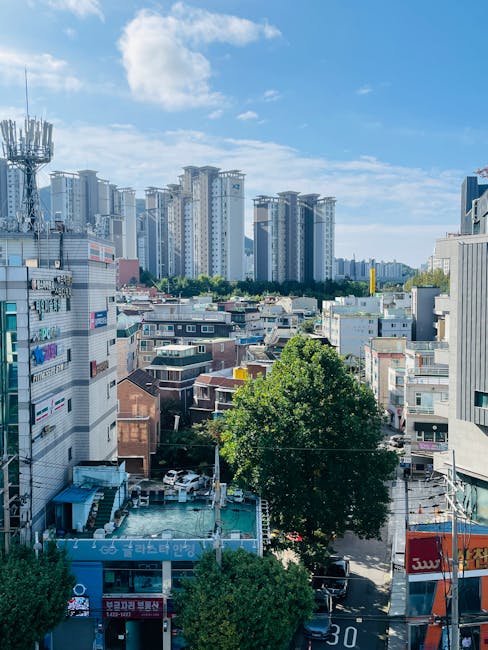 High-rise residential buildings across Seoul. Korea’s 5-digit postal code system covers all addresses nationwide. (Source: Pexels)
Goshiwon vs. Other Korean Housing Options
| Housing Type | Korean | Contract | Meals | Private Bathroom | Address Format |
|---|---|---|---|---|---|
| Goshiwon | 고시원 | Monthly | No | Usually shared | Room [호] + street address |
| Hasukjib | 하숙집 | Monthly | Yes (2 meals/day) | Shared | Street address only |
| Officetel | 오피스텔 | Jeonse or monthly | No | Private | Building name + [동]-[호] |
| Apartment | 아파트 | Jeonse or monthly | No | Private | Complex name + [동]-[호] |
Practical Tips for Foreigners in a Goshiwon
Contract and Payment Advice
The Korea Consumer Agency reported that between 2011 and 2015, 92% of damage-relief cases related to goshiwon contracts (314 out of 341 cases) were rejected by examiners. The majority of affected residents were in their 20s (53.1%) and 30s (20.7%). (Source: Wikipedia – Gosiwon)
To protect yourself:
- Always sign a written contract — verbal agreements are not enforceable
- Pay by credit card or bank transfer and always request a cash receipt (현금영수증) for cash payments
- Clarify the non-refundable clause before signing — upon early termination, the manager must deduct 10% of the remaining fees and refund the balance
- Take photos of the room condition on move-in day
Address Registration Tips
- Ask your goshiwon manager for a written confirmation of your address including the exact room number (호) and 5-digit postal code
- Verify the romanized spelling of your street name at juso.go.kr
- Do not use the old lot-number address system (번지/지번) — it was officially decommissioned on December 31, 2013 and is no longer accepted on government forms
Frequently Asked Questions
What does 호 (ho) mean in a goshiwon address?
호 (ho) is the Korean word for “unit” or “room.” In a goshiwon address, it identifies your specific room within the building. Always include your 호 number on official documents and delivery forms — without it, couriers and government offices cannot identify your exact location.
Can foreigners legally live in a goshiwon in Korea?
Yes. Goshiwon are available to both Korean nationals and foreigners. If you plan to stay in Korea for more than 90 days, you must register your goshiwon address with the Korea Immigration Service and obtain an Alien Registration Card. Contact the Immigration Contact Center at 1345 (or +82-2-1345 from overseas) for guidance.
How do I look up the official English address of my goshiwon?
Use Korea’s official address portal at juso.go.kr. Enter the Korean address and it returns the official romanized English version with the correct street suffix and building number.
What is the correct format for a Korean postal code?
South Korea uses a 5-digit postal code. It appears after the city name — for example: Seoul 03174. Your goshiwon manager or the juso.go.kr portal can confirm your exact postal code.
What is the difference between the old and new Korean address system?
The old system used lot numbers (지번) assigned by order of land registration — not in any logical geographic sequence, making navigation extremely confusing. The new road name address system (도로명주소), fully in effect since December 31, 2013, uses street names and sequential building numbers similar to Western address systems. Always use the new system on official documents. (Source: Wikipedia – Addresses in South Korea)
Getting Your Goshiwon Address Right the First Time
Understanding your Korean address is essential for registering with immigration, opening a bank account, and receiving mail. For goshiwon residents, the critical detail is always including your room number (호) — without it, deliveries cannot be completed and government offices may reject your forms.
Korea’s road name address system has been the official standard since July 29, 2011, and is designed to be logical and foreigner-friendly. Use the official lookup tool at juso.go.kr to verify your address romanization, and contact the Korea Immigration Service at 1345 if you need help registering your place of residence.
Need to convert your Korean address to English format or look up a postal code? Try our Korean address tools at Jusome for quick, accurate results.
Sources / 참고 자료
- Wikipedia – Addresses in South Korea — Road name address system structure, street suffix classification, building number rules, English format examples, postal code format
- Wikipedia – Gosiwon — Legal definition, historical growth data (Seoul 2001–2008), nationwide facility count (2006), resident demographics, Korea Consumer Agency contract dispute statistics (2011–2015)
- juso.go.kr – Korea Road Name Address Information Portal (행정안전부) — Official government address lookup and English romanization tool
- Korea Immigration Service (법무부 출입국외국인정책본부) — Alien registration requirements; Immigration Contact Center: 1345 / +82-2-1345
- Seoul Metropolitan Government – Housing for Foreigners — Overview of housing types and rental systems in Seoul
본 글은 위 공식 출처에서만 정보를 인용하여 작성되었습니다. 정보가 변경될 수 있으니 최신 정보는 공식 사이트에서 확인하세요.
What to do next
Guides for actually using your Korean address abroad.