Korean Officetel vs Apartment Address: Key Differences Explained (2026)
July 30, 2026
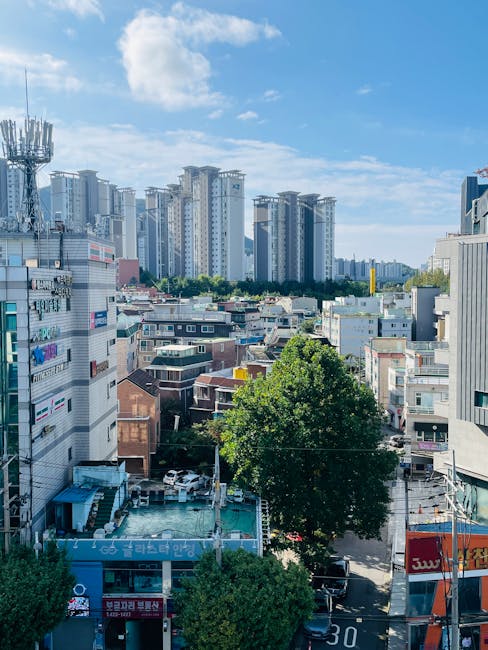
South Korea’s urban landscape features both sprawling apartment complexes (아파트) and mixed-use officetel buildings (오피스텔) — and their addresses follow different structural rules. (Photo: Pexels)
When you’re filling out a Korean shipping form, registering for an alien registration card, or opening a bank account in Korea, one question trips up nearly every foreigner: is this address for an apartment or an officetel — and does it matter?
The short answer is yes — it does matter. Korean apartments (아파트) and officetels (오피스텔) belong to different legal building categories, appear differently on official documents, and follow distinct address formats. Getting the format wrong can delay international deliveries, cause form rejections at government offices, or create mismatches on your alien registration card.
This guide explains exactly how the two address types differ, based on Korea’s official road name address system (도로명주소) and the building classification framework under Korean law.
Key Takeaways
- Apartments (아파트) are classified as collective housing (공동주택); officetels (오피스텔) are classified as business facilities (업무시설) under Korean building law.
- Apartment addresses include a building number (동, dong) within the complex; officetel addresses typically do not use a dong number.
- Both building types use Korea’s 5-digit postal code system, introduced August 1, 2015.
- For international shipping, the building type must be correctly indicated — especially for courier services that verify address details against the official 도로명주소 database.
- Both apartment and officetel addresses are valid for alien registration, banking, and visa applications in Korea.
What Is a Korean Apartment (아파트)?
In Korea, the word “apartment” (아파트, apat-eu) refers specifically to a multi-story residential building of five or more floors, developed and sold as individual ownership units. As of 2019, a majority of Koreans live in apartments — they have been the dominant residential form since the 1980s and represent the largest asset class in the Korean middle-class household portfolio (Wikipedia, Apartment).
Under Korean law, apartments fall under the category of 공동주택 (collective housing) governed by the Housing Act (주택법). The official building classification further distinguishes 아파트 from row houses (연립주택) and multi-household houses (다가구주택).
Apartment complexes are typically large developments containing hundreds or even thousands of units across multiple numbered buildings. Each building within the complex is assigned a dong (동) number — a key feature that directly affects address format.
What Is a Korean Officetel (오피스텔)?
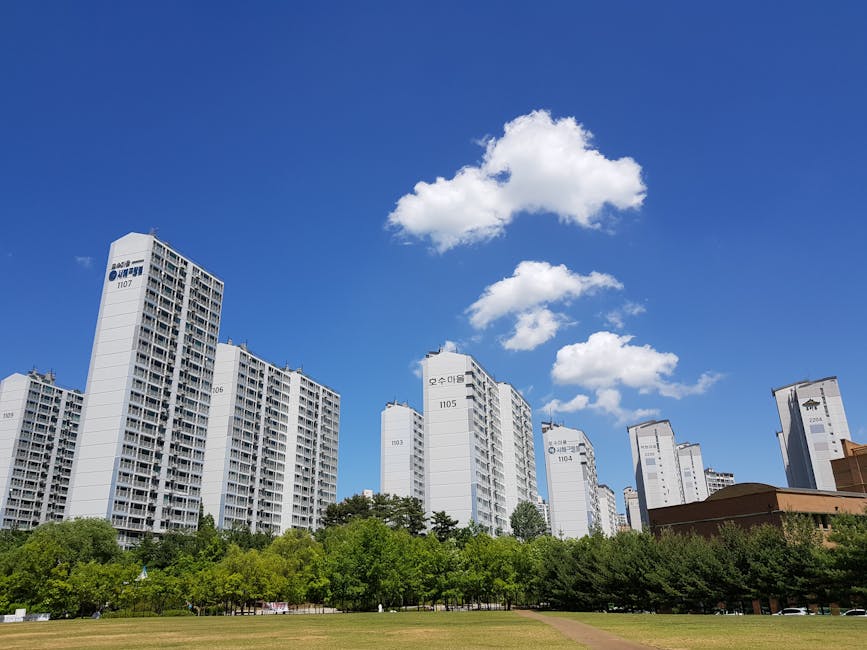 High-rise apartment and officetel buildings coexist across Korea’s major cities. Yongin, shown here, is part of the broader Seoul Metropolitan Area where officetels are especially concentrated. (Photo: Pexels)
The term “officetel” (오피스텔) is a Korean portmanteau combining office and hotel. According to Wikipedia’s entry on the subject, an officetel is defined as “a multi-purpose building with residential and commercial units” designed so that occupants can “live and work in the same building, minimizing commute time.”
The first officetel in Korea opened in Mapo, Seoul in 1985, developed by the Korea Development Corporation. Construction of officetels expanded rapidly after the 1997 Asian financial crisis, driven by government deregulations. Today, officetels are concentrated “downtown or around major transportation hubs” and are especially common in the Seoul Metropolitan Area.
Physically, officetel units typically measure between 50–100 m² (approximately 540–1,080 sq ft). Korean law currently prohibits officetel units from having bathtubs or balconies. Floor heating (ondol, 온돌) was initially banned but became legal up to 85 m² under Ministry of Territories and Oceans Decree 2010-351 (Wikipedia, Officetel).
Crucially for address purposes: officetels are legally classified as 업무시설 (business facilities) under the Building Act (건축법), even when used primarily as residential units. This classification determines how the building is registered — and how its address is formatted.
Korea’s Road Name Address System (도로명주소)
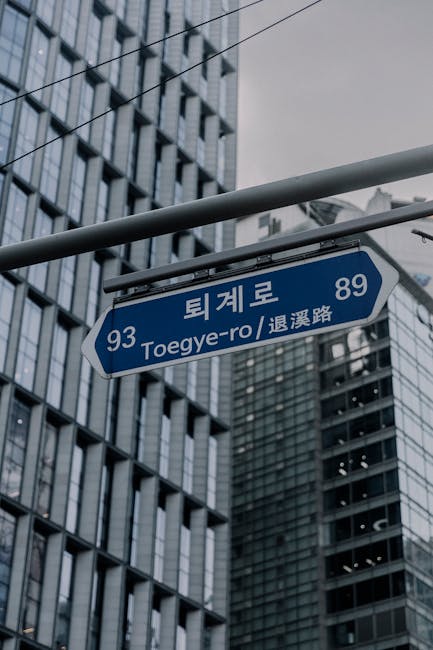 Seoul’s road name signs (도로명주소 표지판) are the foundation of Korea’s modern address system, in use officially since 2014. All addresses — apartment and officetel alike — reference road names and building numbers. (Photo: Pexels)
Since January 1, 2014, Korea has officially used the road name address system (도로명주소), administered by the Ministry of the Interior and Safety (행정안전부). This replaced the older lot-number system (지번주소) that had been in use since the Japanese colonial era.
Under the road name system, every address is built from:
- Administrative unit — Province/Metropolitan city (시/도) → District (시/군/구)
- Road name (도로명) — The official name of the street
- Building number (건물번호) — A sequential number assigned to the building along that road
- Detail address — The unit-level information, which differs between apartments and officetels
As of November 2023, Korea has 34,605 postal zip codes and approximately 6.4 million registered road name addresses under this system (Wikipedia, Postal Codes in South Korea). The postal code itself is a 5-digit number introduced on August 1, 2015, where the first three digits identify the municipality and the last two identify the sub-district.
Apartment vs Officetel: Address Format Comparison
The most visible difference between an apartment address and an officetel address is the presence or absence of a dong (동) number — the building identifier within a complex.
| Element | Apartment (아파트) | Officetel (오피스텔) |
|---|---|---|
| Legal classification | 공동주택 (Housing Act) | 업무시설 (Building Act) |
| Building type on registry | 아파트 | 오피스텔 |
| Dong (동) in address | Yes — required for multi-building complexes | Usually no; only if multi-tower structure |
| Unit indicator | [Dong]동 [Unit]호 | [Unit]호 only |
| Postal code | 5-digit (same system) | 5-digit (same system) |
| Valid for alien registration | Yes | Yes |
| Valid for banking | Yes | Yes |
| Balcony / tub permitted | Yes (balcony common) | No (legally prohibited) |
Korean Address Format — Apartment
A standard Korean apartment address follows this structure:
[시/도] [구/군] [도로명] [건물번호], [단지명] [동]동 [호]호
City/Province  District  Road Name  Bldg No.  Complex Name  Dong  Unit
Korean Address Format — Officetel
A standard Korean officetel address follows this structure:
[시/도] [구/군] [도로명] [건물번호], [오피스텔명] [호]호
City/Province  District  Road Name  Bldg No.  Building Name  Unit
Notice the absence of a dong number. Because most officetel buildings are single-tower structures, there is no need for a building identifier within a complex.
How to Write a Korean Address in English
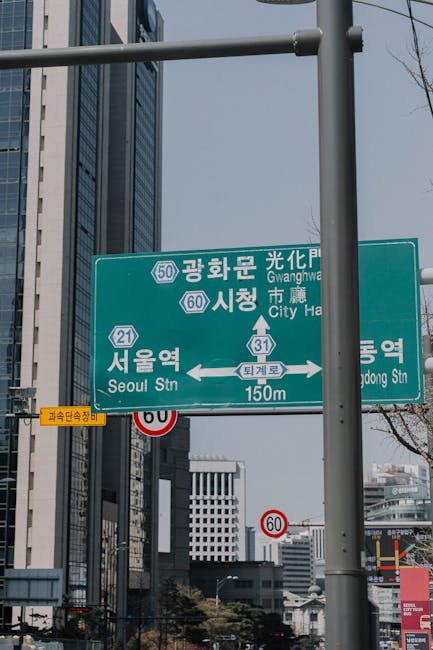 Downtown Seoul directional signage uses both Korean and romanized road names — the same names that appear in official English-format addresses for international shipping. (Photo: Pexels)
For international shipping labels, visa applications, and correspondence with foreign institutions, the Ministry of the Interior and Safety provides an official romanization and English-format guide through the Juso address portal at juso.go.kr.
The official English format reverses the Korean order — smallest unit first, country last:
Apartment (English format)
[Unit]ho, [Dong]dong, [Complex Name] Apt.,
[Building Number] [Road Name], [District], [City] [Postal Code],
Republic of Korea
Officetel (English format)
[Unit Number], [Building Name] Officetel,
[Building Number] [Road Name], [District], [City] [Postal Code],
Republic of Korea
For international courier services (DHL, FedEx, UPS, EMS), always include the full 5-digit postal code, romanized road name, and unit-level detail appropriate to your building type.
Practical Differences: Shipping, Visa & Banking
International Shipping
Courier services that integrate with Korea’s address verification database at juso.go.kr cross-check addresses against the official registry. An apartment address missing the dong number, or an officetel address with an invented dong number, can fail verification. Confirm your full registered address at juso.go.kr before placing international orders.
Alien Registration Card (외국인등록증)
The Korea Immigration Service requires the exact road name address as registered in the national database. When registering, your lease contract (전세 or 월세 계약서) must show the full 도로명주소 including unit-level detail. Both apartment and officetel addresses are valid.
Banking
Korean banks accept both address types. Online banking KYC processes may verify your address against the government database in real time — enter your address exactly as it appears on your lease to avoid verification failures.
LH (Korea Land Housing Corporation) Public Housing
Korea Land Housing Corporation (한국토지주택공사, LH) manages both public rental apartments and public officetel units. LH-managed apartments follow the standard apartment address format with dong and ho numbers. LH-managed officetels use the standard officetel format without a dong designator. Your LH lease agreement specifies which building type applies.
Frequently Asked Questions
Does a Korean officetel count as a home address for official documents?
Yes. Despite being classified as a business facility under the Building Act, an officetel registered as your place of residence is a fully valid address for alien registration, banking, and government submissions in Korea.
Why does my officetel address have no dong number?
Most officetel buildings are single towers, so there is no need to identify which building within a complex. Your address goes directly from the building number on the road to the unit number (호). Rare multi-tower officetel complexes may use a tower identifier, but it differs from the apartment-style dong system.
Can I use my Korean officetel address for e-commerce orders?
Yes. Both apartment and officetel addresses are recognized by all major Korean and international e-commerce platforms. For international orders, include the building name and 5-digit postal code in the English format described above.
How do I find my exact registered Korean address?
Search at juso.go.kr, the official Ministry of the Interior and Safety address portal. Enter your building name or road name to retrieve the exact registered 도로명주소 including unit-level detail.
What is the difference between 동 (dong) and 호 (ho)?
동 (dong) = the building number within an apartment complex (e.g., “101동” = Building 101). 호 (ho) = the individual unit number (e.g., “302호” = Unit 302). Officetels use only 호; apartments require both 동 and 호.
Do postal codes differ for apartments vs officetels?
No. Both use the same 5-digit postal code system introduced August 1, 2015. Postal codes are assigned by road location, not building type. As of November 2023, Korea has 34,605 zip code zones covering approximately 6.4 million registered road name addresses.
Conclusion
The core difference between a Korean apartment address and an officetel address comes down to one element: the dong (동) number. Apartments require dong + ho; officetels use ho only. Both types operate within the same national road name address system, use the same 5-digit postal code, and are valid for every official purpose in Korea.
To look up your exact registered address or convert it to English format, use Korea’s official address portal at juso.go.kr. For additional address translation support, Jusome provides Korean-to-English address conversion and format guidance.
Sources / 참고 자료
- Wikipedia — Officetel — Definition, legal restrictions (no tub/balcony), ondol decree (Ministry of Territories and Oceans Decree 2010-351), first officetel (1985, Mapo, Korea Development Corporation), unit size range (50–100 m²)
- Wikipedia — Postal Codes in South Korea — 5-digit system (August 1, 2015), 34,605 zip codes, 6.4 million registered road name addresses (November 2023)
- Wikipedia — Apartment (Korean section) — Majority of Koreans live in apartments (as of 2019)
- 주소정보누리집 — juso.go.kr — Ministry of the Interior and Safety official road name address search and English format portal
- 도로명주소법 (Road Name Address Act) — Korea National Law Information Center; legal basis for the road name address system since 2014
본 글은 위 공식 출처에서만 정보를 인용하여 작성되었습니다. 정보가 변경될 수 있으니 최신 정보는 공식 사이트에서 확인하세요.
What to do next
Guides for actually using your Korean address abroad.